
Fence Post Spacing Calculator: How Far Apart Should Fence Posts Be?
- January 19, 2026
The longevity of a fence isn’t determined by the quality of the pickets alone; it’s dictated by the engineering of the skeleton beneath. When fence posts are spaced too far apart, the structure sags under its own weight or topples during the first heavy windstorm. Conversely, over-spacing leads to awkward panel gaps and wasted materials.
A fence post spacing calculator isn’t just a convenience—it’s a precision tool that ensures your property line remains straight, stable, and code-compliant for decades.
What Is Fence Post Spacing & Why It Matters
Fence post spacing refers to the center-to-center distance between two consecutive vertical posts. While it might seem like a simple measurement, this distance is the “stress-bearing” interval of the entire system.
- Structural Integrity: Posts act as the anchors. Proper spacing prevents the horizontal rails from bowing under gravity or the “sail effect” of wind.
- Durability: Incorrect spacing leads to premature wood rot or vinyl cracking due to uneven weight distribution.
- Aesthetics: Consistent spacing creates a professional, symmetrical look. Irregular gaps are the hallmark of a DIY project gone wrong.
How Far Apart Are Fence Posts Typically?
For most residential projects, the “Gold Standard” is 8 feet. This isn’t an arbitrary number—it aligns with standard lumber lengths (8-foot rails) available at hardware stores, minimizing waste and cutting time.
| Fence Type | Standard Spacing | Maximum Spacing |
| Wood Privacy | 6 – 8 ft | 8 ft |
| Chain Link | 8 – 10 ft | 10 ft |
| Vinyl/PVC | 6 – 8 ft | 8 ft (Panel dependent) |
| Agricultural/Wire | 10 – 12 ft | 20+ ft (High-tensile) |
Factors Influencing Your Distance
- Material Weight: Heavier wood (like pressure-treated pine) requires tighter spacing than lightweight aluminum.
- Wind Load: If you live in a coastal or open-plain area, reducing spacing from 8 feet to 6 feet can prevent the fence from acting like a giant sail and snapping.
- Terrain: Hills and slopes require shorter spans to maintain ground clearance.
Fence Post Spacing Calculator – How It Works
A calculator uses three primary inputs to determine your layout: Total Fence Length, Post Width, and Desired Spacing. To calculate the number of posts and exact spacing manually, use the following formulas:
The Spacing Formula
To find the exact distance between posts for a perfectly even run:
$$S = \frac{L}{P}$$
- $L$ = Total Length of the fence run
- $P$ = Number of sections (determined by rounding up $L \div \text{Desired Spacing}$)
The Post Count Formula
To determine how many posts you need to purchase:
$$N = \lceil \frac{L}{S_{max}} \rceil + 1$$
- $N$ = Total number of posts
- $L$ = Total length
- $S_{max}$ = Maximum allowable spacing (usually 8 ft)
Using a calculator ensures that if your fence run is 35 feet, you don’t end up with four 8-foot sections and one awkward 3-foot section. Instead, the calculator distributes the distance evenly to five 7-foot sections.
Fence Post Spacing by Fence Type
Post Spacing for Wood Fence
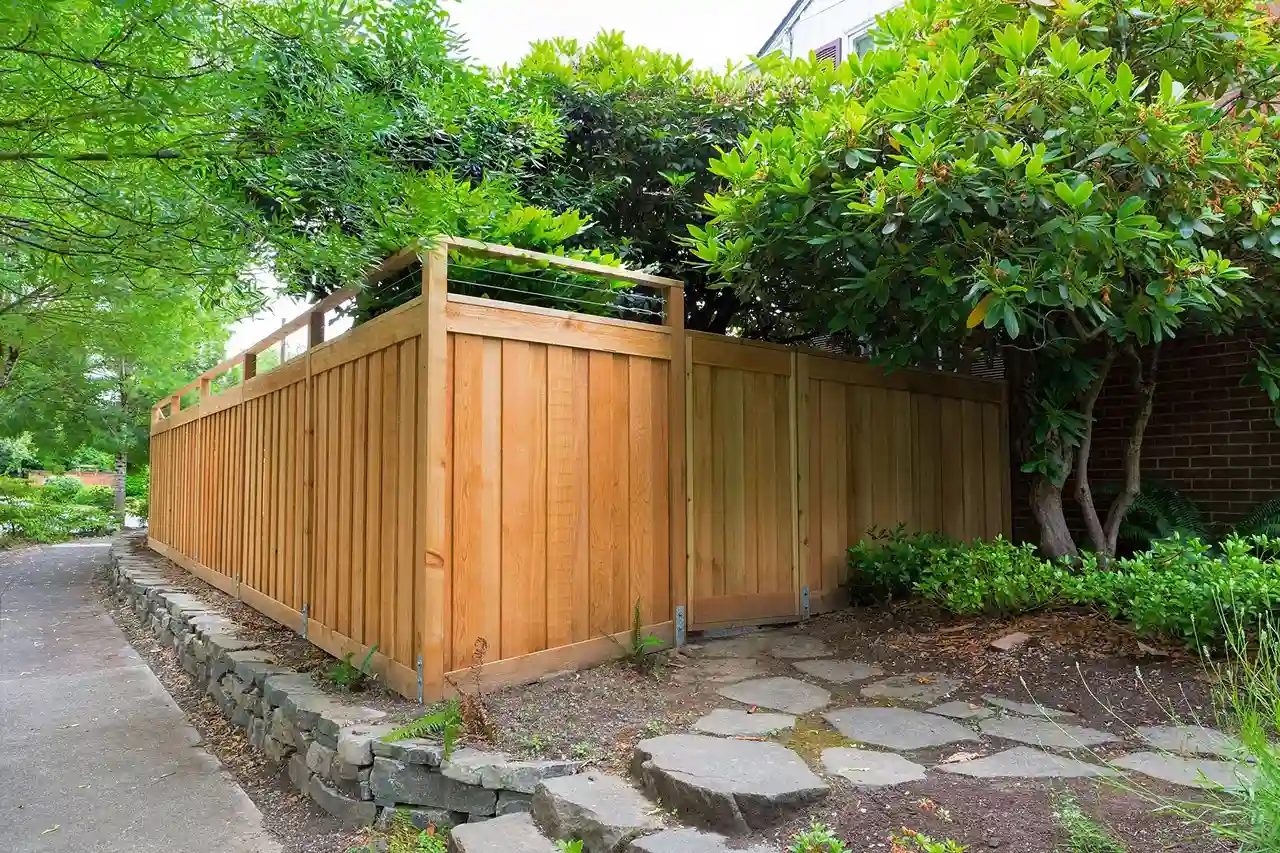
For a 6-foot privacy fence, 8-foot spacing is the upper limit. If you are using heavy pickets or live in a windy corridor, 6-foot spacing is recommended. Picket fences (4 feet tall) are lighter and can comfortably handle the full 8-foot span.
Chain Link Fence Post Spacing
Chain link is incredibly forgiving because the “mesh” doesn’t catch wind. Standard line posts (the smaller middle posts) are typically 10 feet apart. However, the terminal posts (corners and ends) must be set deeper and can be spaced closer if the fence exceeds 8 feet in height. Proper chain link fence post spacing ensures maximum strength, stability, and long-term durability of your fence.
Vinyl Fence Post Spacing
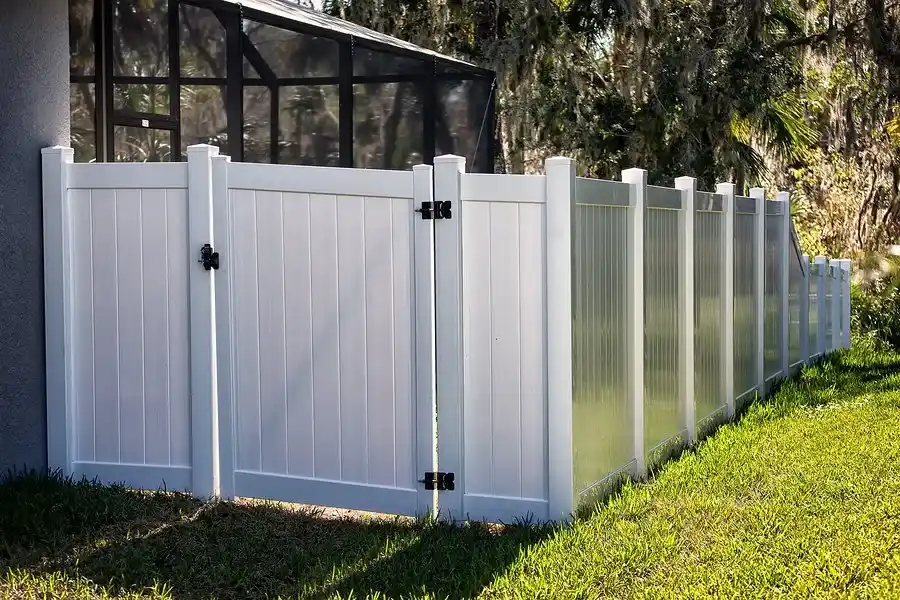
Vinyl is unique because it relies on pre-fabricated panels—you can’t “stretch” or “shrink” a vinyl panel. This means you must measure the exact center-to-center distance of the panel’s mounting brackets, which is usually precisely 6 or 8 feet. There is zero margin for error, making accurate post spacing essential for a clean, secure, and long-lasting vinyl fence.
Fence Spacing Chart (Quick Reference Guide)
| Fence Height | Material | Recommended Spacing | Purpose |
| 4 ft | Wood Picket | 8 ft | Decorative/Boundaries |
| 6 ft | Wood Privacy | 6 – 8 ft | Maximum Privacy/Wind Resistance |
| 6 ft | Vinyl | 6 ft or 8 ft | Low Maintenance |
| 4 – 6 ft | Chain Link | 10 ft | Security/Pet Containment |
| 8 ft | Wood/Security | 6 ft | High-Stakes Privacy |
Fence Post Spacing by Fence Height
Height significantly alters the physics of a fence.
- 4-Foot Fences: Minimal wind resistance. 8-foot spacing is standard.
- 6-Foot Fences: This is the threshold where wind load becomes a factor. Use 8-foot spacing for sheltered yards and 6-foot for open areas.
- 8-Foot and Taller: These require “Heavy Duty” protocols. Spacing should be reduced to 6 feet, and posts should be upgraded from 4×4 to 6×6 to handle the lateral pressure.
Corner, End & Gate Post Spacing Rules
Terminal posts (Ends, Corners, and Gates) are the anchors of your system. They handle the tension of the entire fence line.
- Corner Posts: Must be perfectly plumb, as they pull from two different directions.
- Gate Posts: These require the most precision. You must account for the “Gate Opening” plus the width of the hardware (latches and hinges). Usually, you leave a gap 2-3 inches wider than the gate itself.
- Depth Rule: While line posts are usually buried 24-30 inches, terminal and gate posts should always reach below the frost line—often 36-42 inches.
Adjusting Fence Post Spacing for Slopes & Uneven Ground
If your yard isn’t flat, standard spacing will leave large gaps at the bottom of the fence. You have two options:
- Stepped Method: The fence looks like a staircase. This requires shorter post spacing (5-7 feet) to ensure the “steps” aren’t too high for pets or children to crawl under.
- Racked Method: The fence rails follow the angle of the ground. This works best with wood or specially designed “racking” vinyl panels. Spacing stays closer to 6-8 feet, but post heights must be adjusted carefully.
Common Fence Post Spacing Mistakes to Avoid
- Over-Spacing for Budget: Trying to save money by spacing posts 10 or 12 feet apart for a wood fence is a recipe for a “wavy” fence within two years.
- Ignoring Soil Conditions: In sandy soil, posts have less “grip.” You must reduce spacing or use significantly larger concrete footings.
- Measuring “In-Between” Instead of “Center-to-Center”: Always measure from the middle of one post to the middle of the next. Measuring the gap between them will result in rails that are too short to be secured.
Final Thoughts
Precision at the start of your project saves hundreds of dollars in wasted lumber and hours of corrective labor. By using a fence post spacing calculator, you transition from “guessing” to “engineering.”
Whether you are installing a classic cedar privacy fence or a modern vinyl perimeter, stick to the 6-to-8-foot rule, account for your local wind conditions, and always prioritize the depth of your terminal posts. If the terrain is complex or the height exceeds 8 feet, consulting a professional installer ensures your investment remains standing for the long haul.
FAQs
Standard spacing is 8 feet, but for 6-foot privacy fences in windy areas, 6 feet is preferred to prevent leaning.
Most residential chain link fences use 10-foot spacing between line posts.
Highly accurate, provided your initial measurement of the total fence run is precise. It is the best way to ensure even spacing across a long run.
Yes. Taller fences (8 feet+) require closer spacing (6 feet) and sturdier posts to withstand wind pressure.
Only for specific materials like chain link (10 ft) or high-tensile wire (up to 25 ft). For wood, vinyl, or composite, exceeding 8 feet will cause sagging.
Vinyl spacing is fixed by the panel size. Most manufacturers design panels for either 6-foot or 8-foot center-to-center spacing.
They don't necessarily need different spacing from the rest of the line, but they require much larger concrete footings and more depth to handle tension.
Estimate Your Fence Cost — Fast & Free
Get a Quick Quote With Estimate in Minutes.
Latest Post