Chain Link Fence Slats for 2026: Privacy Options, Types, Costs & Installation Guide
Quick answer: the best pool fence idea for your home comes down to three things: how much privacy you want, which material fits your budget and maintenance tolerance, and the safety requirements your pool needs to meet regardless of style. Below, we walk through the most popular pool fence styles for 2026, the materials that actually hold up around water, ideas for different pool types, and the safety basics and common mistakes every pool owner should know before choosing a fence.
Before landing on a specific material, it helps to think about which general style direction fits your yard. Pool fence styles generally fall into a few categories: open, see-through styles that keep sightlines clear for supervision, solid privacy styles that block views into the pool area entirely, and decorative styles that focus more on curb appeal than seclusion. The right starting point usually depends on whether visibility or privacy matters more to your household, something worth settling before comparing materials.
If blocking outside views into your pool area is the priority, a few approaches tend to work well. Taller solid panels, whether vinyl or composite, create a full visual barrier without gaps. Some homeowners pair a slightly shorter fence with strategic landscaping, such as shrubs or trellising along the fence line, to soften the look while still adding privacy. A pool privacy fence doesn’t have to feel like a wall either. Horizontal slat designs and varied panel spacing can create privacy while still looking intentional. Just keep in mind that horizontal rails on the outside of a pool fence can act as footholds, so confirm the design meets barrier rules before committing (more on this below).
Not every fence material holds up the same way around a pool. Chlorine, moisture, and constant sun exposure are harder on some materials than others, so it’s worth understanding what each option actually offers before deciding.
As a pool fence material, aluminum resists rust and corrosion, which matters given how much moisture and chlorine exposure a pool-area fence deals with. It’s also a common choice where an open, see-through style is preferred, since aluminum panels can be designed with clean vertical lines that don’t block sightlines the way a solid privacy fence would.
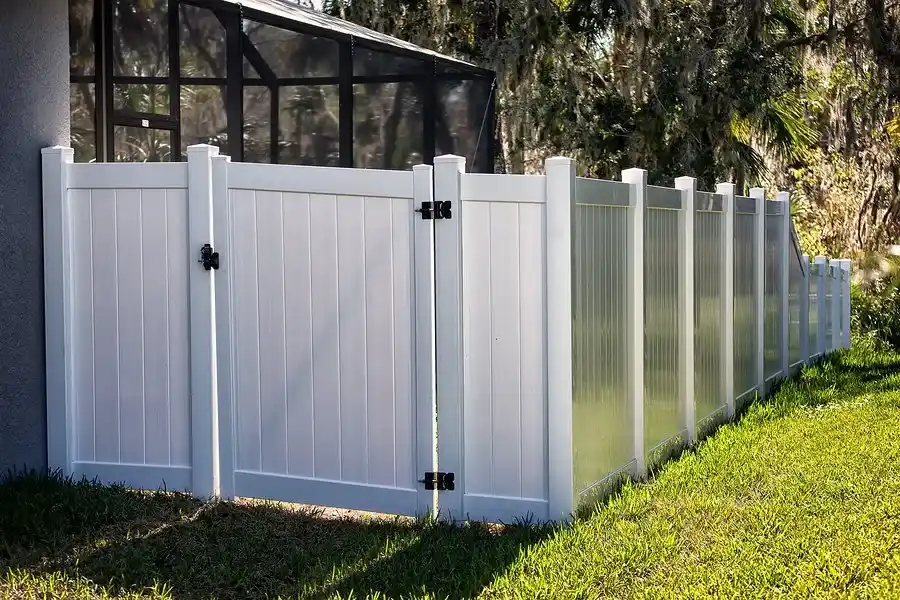
For homeowners who want low upkeep, vinyl holds up well against moisture and doesn’t require staining or sealing, making it a low-maintenance option for a pool-area fence. It also works well for privacy-style fencing, since solid vinyl panels create a clean, uniform barrier without the upkeep wood would require in a high-moisture environment.
For homeowners working with a tighter budget, chain link is typically the most budget-friendly option and remains a functional, durable choice around a pool. It won’t offer the privacy that vinyl or a solid panel style provides, but for homeowners prioritizing cost and durability over seclusion, it’s a practical option. For pool use, the mesh size matters: CPSC guidelines call for a smaller mesh than standard fencing, or slats that close up the openings, so ask your installer for pool-appropriate chain link.
Not every home needs the same approach. A couple of common scenarios worth thinking through:
If cost is the main driver of your decision, a pool fence doesn’t have to be expensive to be effective. Chain link and simpler panel designs can both meet safety requirements without the price tag of a full privacy build. For a sense of what your specific project might cost, our fence price calculator gives you an instant estimate.
The right pool fence also depends on the pool itself: whether it’s in-ground or above-ground, how close it sits to the house, and its shape. Use this as a quick guide:
| Pool Type | Fence Approach to Consider |
|---|---|
| In-ground pool | A dedicated four-sided barrier that separates the pool from both the yard and the house, rather than fencing the whole property. |
| Above-ground pool | The pool wall can act as part of the barrier, but the ladder or steps are the weak point. Use a ladder that locks, flips up, or can be removed when the pool is not in use. |
| Pool close to the house | Any door that opens straight to the pool area needs extra protection, such as a door alarm or a self-closing, self-latching door. |
| Small backyard pool | Open aluminum or glass-look styles keep the space feeling larger and make supervision easier. |
| Irregularly shaped pool | Panel systems or segmented fencing that can follow curves and angles without leaving gaps. |
The ladder and door guidance above reflects the U.S. Consumer Product Safety Commission’s Safety Barrier Guidelines for Home Pools, which is worth reading in full if your house wall forms one side of the pool area.
Whatever style or material you choose, a pool fence has one job that matters more than any other: keeping people, especially young children, from wandering into the pool area unsupervised. According to the U.S. Consumer Product Safety Commission’s Pool Safely campaign, pool fences should be at least four feet tall, and gates should be self-closing and self-latching so they shut and lock automatically rather than relying on someone remembering to close them. The campaign also recommends four-sided fencing, meaning a barrier that fully surrounds the pool rather than using the house itself as one side of the enclosure, since that fourth wall is often where a home’s fencing coverage has a gap.
These aren’t small details. CPSC estimates that nearly 300 children under the age of five drown in pools and spas each year, most often during moments when supervision briefly lapses, which is exactly the scenario a properly installed, self-latching pool fence is designed to guard against. Before finalizing your design, check with your local building department, since pool barrier height and gap requirements can vary by city and state on top of these baseline federal recommendations.
Most pool fence problems come from small design or installation details, not the material itself. The mistakes below are the ones most likely to weaken a pool barrier, and several map directly to measurements in the CPSC barrier guidelines.
A pool fence only protects your family if it keeps working. A quick inspection every few months, plus a full check before swim season, helps you catch small problems before they turn into safety gaps.
There’s no single best pool fence. The right choice is the one that balances your privacy preference, your budget, and the safety basics covered above. A vinyl privacy fence and an aluminum open-style fence can both be excellent choices; they just serve different priorities. Whatever direction you lean, make sure the final design meets a four-foot minimum height with a self-closing, self-latching gate, and check it against your local pool barrier code before installation. Ready to talk through options for your pool area? Get in touch for a free quote.
Chain link is typically the most budget-friendly pool fence material. It won't offer much privacy, but it's durable and can meet safety requirements at a lower cost when the mesh size or slats are pool-appropriate.
Yes. The CPSC's Pool Safely guidelines recommend self-closing, self-latching gates on any pool fence, so the gate shuts and locks automatically rather than depending on someone remembering to close it.
CPSC barrier guidelines recommend the latch release sit at least 54 inches above the bottom of the gate. If it's lower, it should be on the pool side of the gate, near the top, so a child outside can't reach it.
Solid vinyl or composite panel fencing tends to offer the most privacy, since taller, solid panels block sightlines into the pool area more completely than open styles like aluminum or chain link.
Yes. Aluminum resists rust and corrosion, which matters given the moisture and chlorine exposure around a pool, and it works well for homeowners who prefer an open, see-through style.
Get a Quick Quote With Estimate in Minutes.